Showing posts with label G321 Thriller Research. Show all posts

Tuesday, 10 November 2009

Notes on Film Openings

LA Confidential


Conventional film noir themes:
- Voiceover
- Dark room, lit with lamps
- Iconic props, guns, cigerettes
- sets a timeframe of the 80s/90s with the old fashioned type writers and attitude to family life.

Non-conventional film noir themes:
- Mood is happy
- Bright sunshine, natural light
- Jazzy music
- Colour
- Wide open spaces
- Public places

Music starts before picture. Voiceover sets a scene of LA being wonderful and amazing, but he suddenly changes and talks about the dark side of LA which contrasts his happy demenour and the jazzy music.

Main characters introduced nut not much is said about his personality. Audience cant relate to him yet. Talks about the image of LA and how wrong it is. The voiceover talks about criminals quite lightly, saying a bodyguard is a "dapper gent" which puts a upbeat spin on a dark subject.

Notes on Film Openings

Lock Stock and Two Smoking Barrels


The main character is portrayed as a wheeler-dealer in the opening of the movie, he can be related to Del boy from 'Only Fools and Horses' which gives the audience an expectation of what may happen in the film.

Conventional film noir features:
- Themes of crime
- Stairways
- Voiceover

Non-conventional film noir features:
- Public places
- Natural daylight
- Personality of character, light-hearted, funny,

British gangster films represent criminality in terms of lovable rogues and cheeky guys, its fails to engages with themes of morality and humanity like in film noir films.

Notes on Film Openings

Layer Cake


- Camera merges between scenes, long slow panning shots, slow motion.
- British markers (cobble stones, zebra crossing)
- Modern
- Theme, crime and drug industry,
- Main character is smartly dressed but not enough to stand out in a crowd.
- Camera constantly moving in the opening scenes which creates a smoothness in the scenes.
- Camera shots used to try and include the audience,
- Voiceover makes the audience feel close to the main character, film noir convention.
- Lighting used to draw audience attention to specific people and objects such as the table which two of the characters are working on.
- Lighting with the main character is warm, lighting on drugs is detatched and clinical.

The main character has a sense of humour and has all the qualities of a good person, except he isn't. These qualities make his relatable to the audience and the danger aspect of his job makes him seem exciting and adventurous.

Most of the lighting in the opening is natural in daylight which is not a convention of film noir as film noir is generally the opposite.

Notes on Film Openings

Sin City


Black and white like old film noir films but the womans dress, lips and eyes are in colour and draw audience's attention.

Iconic props:
- Cigerettes
- Lighter
- Gun

Balcony is in the dark, party in the background makes two characters look isolated, when the camera pulls up away from the scene the characters look even more lonely and insignificant against the huge cityscape.

Film Noir conventions:

- High contrast lighting, (backlighting from party inside)
- Man dressed in black suit with slicked back hair, Women dressed in a red halter neck dress which gives a look of femme-fatale, dialogue makes her look femme-fatale.
- Voiceover,
- Use of night and rain

When the voiceover is speaking after the woman was shot there was no music or soundtrack, just the sounds of the rain which means that audience focuses on what the man is saying.

Notes on Film Openings

Se7en


Film opening:

- Sets timeframe (modern time, 21st century)
- Sets theme (Crime)
- Introduces main characters (Morgan Freeman and Brad pitt as police officers)
- Mood and Atmosphere (Somber)
- Creates enigma's

Opening shows the two main characters as opposites in personality.

Older Man - Asks strange questions, isolated, perfectionist, can't sleep (uses a metronome), lives alone, senior police officers (murders don't surprise him, used to them), dedicated

Younger Man - New to the area, looks at women, friendly, neatly dressed but not overly neat,

The camera switches from views of shaving to a murder, quite drastic difference, shocking. Soun starts before picture, sets the scene before showing one.

Opening title sequence:

- Quick flashing images
- Notebook being written in, pictures of crime scenes, words being omitted from a book, the word 'God' cut out very precisely from a newspaper, all neatly done.
- Crossing out eyes in a picture then the whole thing, sewing sheets of paper together, bandaged fingers, knife cutting fingertips, all look frantic and un-neat.
- The contrast between neat and unneat is quite stark and is unnerving.
- Reminds you of a derranged killer or stalker making a scrap book of deaths.
- Music with pictures is unsettling, close up shots of objects and working hands but the owner of the hands is not shown which is eerie.
- Different camera angles is distrubing because the audience feels unbalanced, could also be a reflection of the unknown person in the opening.
- Text in the opening is scratchy and flickers which further implies the unstable personality of the unknown person.

Notes on Film Openings

Double Indemnity

-chaotic music with empty street with one slightly weaving car, still camera
-finsh 3 shot show chaos, non equalibrium, fast shots, fade to suggest a movement through time.
-backlighting, man linked to man on crutches from the beginning, enigma used.
-chiaroscuro lighting, longer shots, calm pace, camera followes him, idea of iscolation from orderell but empty desk, angular shapes, metaphorical darkness from shadows.
-backlight, lamps in room once turned on, beaurocractic job, isoclation shown by single light.
-very long shot, him getting out cigerettes, editing creates journey. relaxing audience intostory, music still going
-close shots of face, music cut and he becomes the narrator. puts us on his side, implicatioed as his side kicks/accomplies
-fade to another time/scene
-LA, bright light.

Notes on Film Openings

In Bruges

British Gangster Thriller

Film opening - In Bruges

Conventionsl Thriller:
- Close ups of church things
- Voiceover about murder, slang
- Talking snd imsges of london
- Secret about guy/his reaction
- Scenic shots
- Old guy in light s lot. young guy in dark wearing black
- Contrast, gothic, alleys, cobbles, angular
- Weather

Unconventional Thriller:
- Comedy
- Open spaces/light
- Personality of old guy
- Reference to modern culture
- Public, not desolate

Monday, 9 November 2009

Notes on Film Openings

Essex Boys


Film noir conventions, high contrast lighting, background lighting to creat silhouettes. Voiceover of main character to make audience feel connection to him. Tunnel is a metaphor, light from tunnel making bar shaped lines on the car which ties in to the other character having recently gotten out of prison. Bleak landscape, simple ominous music, femme-fatale.

Lots of natural lighting is used but the sky is quite overcast which makes the scene look gloomy. Lots of close up and medium shots used, although the long shot of the van leaving the moor is very good because it shows the isolation of the area and the characters.

Notes on Film Openings

The Black Dahlia


Noir Conventions:

Cigerettes, Voiceover, Light, Sepia colours, Flashbacks, Fighting, Radio Commentary lying about scene, Police, Audience questioning good vs evil (which is which), Blinds, Lamps, Face half in shadows, Slang, Mood and atmosphere change from scene to scene.

The opening scene create enigmas:

- Why are they fighting?
- Why are the police watching but not stopping the fight?
- Why was the main character not fighting?

Clothing of fighters is contrasted, Voiceover mentions binary opposite "fire and ice", The street is dark and the lighting is hightly contrasted with the street lamps and fire. The camera pulls back along the road to show the fighting and the noise fades in to shock the audience.

Notes on Film Openings

The Third Man


The music is cheery and quite upbeat while the pictures are of destroyed buildings and criminal activity which is shocking to the audience. The film is set Vienna which is connected to the war and the images of churchs next to the bombed remains of buildings is highly contrasting. The voice over has a British accent which relates him to the British audience so they feel closer to him, the posh gentleman demenour is quite unnerving when he is talking about criminal activity and murder.

The opening scene has a few shocking pictures such as marching armies and a dead body floating in a river. These are medium shots. The Third Man also does some canted shots which are unnerving because the audience feels unbalanced. The voice over is quite familiar to the audience, treating them like friends.

Thursday, 29 October 2009

Use Of Camera Movement In 'Layer Cake' and 'Essex Boys' and How It Affects The Audience


In ‘Layer Cake’ the camera continually moves during the opening which creates a sense of sophistication, it has this effect because the images merge into each other instead of cutting between them quickly and this smooth merging looks classy and refined. The two most used types of camera movements in the opening are tracking and panning. These two types are very similar to human eye and head movements and make the audience feel involved. The way the scenes merge could also make the impression of drugs as the camera doesn’t stay still and it moves from one thing to the next quickly like the camera has a lack of concentration and this simulates some of drugs effects. The camera merges into a scene of a shop that’s apparently selling drugs and the camera moves along the shelves and shows the different drugs like the audience is browsing through them, the main character is shown doing the same and it makes the audience feel connected to the man. The camera moves to outside the shop where the camera tracks the character from the front which gets all the British icons in the scene such as the zebra crossing which makes the British audience relate to the man because he is British so they feel more connected to him. The camera doesn’t follow the man inside the house but goes up from the outside and fazes through the blinds into the room, it gives the impression that the characters are letting the audience into their lives and showing them their secret, it creates a feeling of trust with the main character and makes the audience feel a part of the crime. The constantly moving camera shows that there is not only three walls, for example in some TV shows like “Friends” where a wall is missing so the audience just observe the lives of the characters, in Layer cakes the walls are present so the audience is included in the scene making them feel more involved, unlike the purely observational stance of “Friends”. The camera pulls away from the scene to show a police car which is used to merge into another scene in Amsterdam where another set of characters are introduced. The characters in this scene are shown in an observational manner; the camera doesn’t go very close and shows the background of Amsterdam which doesn’t relate to the audience so they don’t feel close to them like they do with the British man. The camera seems like it is keeping a distance to these characters so the audience feel the same. Back with the main characters there is a scene showing all of the middle men in the drug business and the camera moves around them but stays quite close which shows the respect the audience should have because they are close to the camera and therefore close to the audience so they should be trusted and respected. The camera seems to walk around the room and it shows everyone in the room as well as some of the props like the cocaine packages and money. The camera moves to stand in front of the main character on the other side of a small table filled with money and the camera pans down to show the money, this shows the audience how big a business that drug trading is and because the money is obviously used in illegal crime the audience feel further drawn in to the story and drug trade as a collaborator in the crime. In the tracking scene used after this the camera is in front of the main character and this gives the audience the impression of being on the same level as the character, rather than if the camera had been following the character. The primary use of camera movement in ‘Layer Cake’ is to involve the audience in the crime as much as possible and make them feel connected with the main character.


In ‘Essex Boys’ the camera switches between views in a room to make the audience feel involved, the camera mainly uses close up shots and switches between outside views of the scene and point-of-view-shots to make the audience feel connected to the main character. In the first scene the camera is still and shows the silhouette of a man, the audience are observing from afar so they can see what is happening but the voiceover draws the audience in while the camera remains stationary. The camera follows the main character and moves into the passenger seat beside him which makes the audience feel involved and the main character feels like a friend because he is explaining to the audience about himself so being next to the character in the passenger seat makes it seem like trust is being created with the audience and main character. The camera tracks the car with the two men inside and follows them into a tunnel which gives the audience the impression that they are being led into something, when the van pulls into the fish market the camera leaves the main character to follow the other man as he walks towards a third man, the camera shifts between the second and third mans point of view to show the audience that they are getting close to each other and to show the second mans intention of hurting the other. The camera pulls back when he starts beating the man up so simulate being either scared of disgusted, the camera looks at the main character a few times as though to see his reaction to the scene, this implies that the audience are on the main characters side and take his reactions into account before making a decision. The camera switches between the main character and passengers point of view to make the audience feel like a part of the conversation. The camera shows a still shot of the marshes and the second man throws the third into the marshes with the intention to leave him, the camera pans to the side as he walks past and shows that the camera was standing next to the main character, the audience would feel like they and the main character were both observers and make them feel connected as they are both witnessing a crime without saying anything which makes them both accomplices. When the main character takes the second man to a rich house the camera stays with the main character at first then moves to the second man which simulates a person walking to the other and looking at what the second man is looking at. The camera acts like a person in the way it moves, it could be related to a shy person as the camera at first remains with the main character like he is protecting it then becomes bolder to look around and see what is happening. This creates a sense of participation and involvement with the audience and creates a sense of trust and confidence with the main character.

In both films the camera is used to make the audience feel involved with the main character. In ‘Layer Cake’ the camera is used to go into the characters lives as a person as the voiceover makes it seem like the character is talking to the audience and telling them secrets of the trade which makes them feel like new recruits to the business and creates a mentor with in the main character but also a friend. In ‘Essex Boys’ the camera is also nearby or close to the main character which forms trust between the main character and audience, the voiceover makes the audience feel like friends with the main character and the camera movement makes the audience feel like they are in the same boat with the main character by witnessing crimes together and both being silent about it.

Wednesday, 7 October 2009

What Is LA Noir, Binary Opposites and Enigma?

LA Noir:


LA noir is like film noir except that instead of darkness and night time with light to create shadows, it is light and cheery and other objects and items are used to create shadows. For example in LA noir it is sunny but the main characters are in a dark room with the curtains or blinds half closed so natural light shines partially through, while in normal film noir the it would be night time or very overcast and the room would be lit with lamps and unnatural light. This makes the audience feel more enclosed and claustropobic becuase the natural light is being hidden. The natural light creates a more innocent atmosphere and the audience becomes shocked at the characters actions because they were decieved by the light, the the natural light is hidden or partially removed so it implies that the innocence and light is being pushed away by the darkness.

LA noir has a very cheerful atmosphere which makes the audience feel unneasy because it contrasts with the themes of the film. The music used in LA noir is normally upbeat Jazz and it is unnerving because its connected with themes of crime, deception and corruption. In LA noir the voiceover has a very important job, because the sunny nature of LA and upbeat music the voiceover has to lead the audience into the dark themes of film noir and show the evil underside of sunny LA.


Binary Opposites:

Binary opposites are stark opposites such as Black/White, Good/Evil, Life/Death, Light/Shadow and Justice/Corruption. Film noir often uses Binary Opposites to create drama and interest, film noir normally shows aspects of human life and society that is hidden and unseen and this in interesting to most audience because it is shown as taboo. In the opening "The Third Man" the Binary Opposites shown are religion in opposite to crime which are shown by flicking through images of angels and churches and then showing a few dealers selling questionable items. Another Binary Opposite is war and peace which is laid on heavily through pictures of ruined buildings, marching armies and the voiceover talking about it, although the peace side of the opposite is more implied than shown becuase the film was set after the war. A third Binary Opposite was the light and shadow when the American was walking on the streets, through the building and finally up the stairs, his shadow is clearly shown on the staircase and when he is walking through the hallway to the stairs the shadows cast by the archway are very clear and create a tension and nervousness which lets the audience know that something may happen.

Enigma:

Enigmas are questions that the film makes in the opening scenes that will be answered later in the film, they are used to engage the audience so they want to know the answers to the questions. In the opening "The Third Man" some of the enigma's are:
"Who is the man in the voiceover?"
"How/why does he know so much about the situation?"
"Is he important to the film?"
"Why is he talking about the war and crime?"
"Who is Harry Lime? and is he important to the film?"
"Why does he call the American 'poor chap'"?

The enigma's are what make the audience watch the film becuase they are curious about what the answers are and how the questions are important to the film. Enigma's are used to create certain expectations that the audience has for the film, for example in "The Third Man" the audience would expect Harry Lime to appear in the film with a important role because he was one of the first people mentioned in the film and because his full name was mentioned the audience would expect Harry Lime to have an even greater importance. Use of Harry Limes full name makes him sound revered and adored so this also creates expectations in the audience.

Tuesday, 6 October 2009

Essay on the Opening of 'Sin City'


The scene opens with a long shot of a woman standing in the rain with her back to the camera in a red backless dress, she is standing on a balcony that looks over the city and lights can be seen from the windows of other buildings against the night which makes the balcony and woman stand out more. The fact that she is partly in colour suggests that she will play an important role. The whole scene is in film noir style and the only colour is the woman’s dress and red lipstick which draws the audience’s eye to her, the red connotes danger and lust.


The camera flicks to a close up shot of her face and shows the space over her shoulder where the man can be seen walking towards her. The man is wearing a black suit and a black tie with slicked back hair that makes him look like the ‘bad guy’ character from the original film noir films which gives an expectation that something bad will happen. The two don’t speak until she turns around to face him and while he is walking towards her there is a voice over that sounds poetic and loving., which implies that he either knows her or loves her. The dialogue between the two is very focused and the sentences are short which adds suspense, this creates the expectation in the audience that something will happen. The man speaks about her in a way that sounds obsessive; he says things such as “I’ve been watching you for days” which makes the audience wonder if the man is good or bad because he sounds like he loves her, but his expression and body language is too cold considering what he is saying. The camera has close up shots of iconic props such as the cigarette and the lighter to make them more memorable and to connote film noir similarities.


The contrast between light and shadow is emphasised when the man lights the woman’s cigarette which throws light on her face and shows her eyes which are bright green to make her look more mysterious and enigmatic. The two standing on the balcony are in the shadows but the party in the background is in the light which makes them look isolated and alone. The camera focuses on the woman’s face a great deal when the man is talking to show her emotional responses and the flirty connection the two seem to share. When the two kiss the colours invert but the scene looks quite cartoon like because the two are completely in white and look like they have been cut out, it looks like a parody of chiaroscuro. The is no more dialogue after the two kiss but the voice over picks up and sounds as poetic and loving as before which connotes love and romance.

The camera shows and close up of the two hugging and there is a flash of light and the camera does a close up on the gun and silencer which shows its significance to the scene, the gun creates surprise in the audience because the voiceover made the audience think that the man loved her but the gun rips that idea away. The voice over language changes from poetic and loving to cold facts that sounds more like an assassin which makes the audience re-think their impressions of him as it seems like his loving obsessions is actually an obsessive nature is for a murder target. The last line of the voice over “I’ll cash her check in the morning” shows the idea of moral ambiguity through the man’s job as an assassin. The scene ends with the camera pulling away from the scene at a high angle that shows the cityscape and makes the murder looks insignificant against the huge buildings and city. The camera pulling away from the scene creates a feeling of isolation and insignificance because the buildings tower over the scene and the characters look very small.

The dialogue is fairly short but it adds a layer of depth and complexity to the characters compared to if he had just shot her and left. The audience finds out that the woman is running from something and the man seems to comfort her but he actually uses her weakness as an excuse to get close to her so he can shoot, the scene emphasizes the woman’s vulnerability and weakness which is a running theme in film noir and this is used to set up the audience for a film that follows mostly male characters with either women like the one in the opening scene, or strong women who try and seduce the male characters.


Women in Film Noir

Femme-fatale: a seductive woman who leads men into danger. Often double crossing, beautiful, unreliable, manipulative and desperate. Thier role in the film is generally to act as the 'evil seductress' who leads the hero into trouble or crime.


Conventional film noir women: dutiful, reliable, trustworthy, and loving. The conventional woman is often 'traditional' in the form of her place as a housewife and mother. The women are normally passive and non-threatening. Thier role in the storyline is to seek the main character/hero but normally loses him (in love). They act as an opposite force to the femme-fatale.

5 examples of conventional women in film noir:
Ann - 'Out of the Past'
Sue - 'Pitfall'
Lagana - 'The Big Heat'
unknown name - 'The Killers'
Melanie - 'Gone with the Wind'

5 examples of femme-fatale women in film noir:
Cathy - 'Out of the Past'
Ida - 'Road House'
Rhonda - 'Cry Danger'
Joan - 'Sudden Fear'
Claire - 'Born to Kill'

Monday, 5 October 2009

Conventions of Film Noir

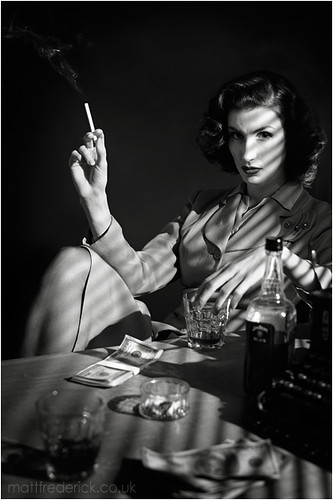
Film noir is normally to do with dark themes such as murder, corruption, crime, loss of love and romance.


The films that are themed around love generally include femme-fatale who are women who try to seduce men and lead them astray. The romance films often have woman who are better known as 'traditional' or 'marrying' type women who try and force the main character of the film into stability which is shown in most of the films as being unwanted and boring. The femme-fatale women are opposite of traditional women becasue they don't want commitments or marriage and give the illusion of more freedom for the male although that is not so in most cases.


The films use lighting to create atmosphere and suspence, becuase the films are in black and white the light and shadows have to be used to create mystery unlike in colour films which can use all sorts of dark colours to create the same atmosphere. In some scenes the shadows are contrasted with light to draw attention to certain things such as an object or person that will be important later in the film. The objects in the scenes are often highly contrasted, for example in "The Third Man" the setting of the film is in Vienna that was bombed in the war which means that many buildings are in ruins but the film also shows scenes of churches and angel which show and visual contrast of good and evil. Good and evil remain a running theme throughout many film noir films becuase it makes more tension and mystery about what will happen in the film.


Directors sometimes angle shots a certain way to make scenes look more scary and unnerving, some of these shots include high angle shot that make the subject look smaller and more vulnerable and this is normally used on victims or innocent characters. Long shots are used in some chase scenes or confrontational scenes so all the characters and surroundings can be seen which creates suspence, for example if a chase scene ended in an alley or enclosed space it would add more expectancy and apprehension becuase the surrounding space is small and can cause a feeling of claustrophobia and anxiety. Many scenes are medium shot becuase the objects and scenery in the backgroun help establish different expectations when coupled with the action in the scene and background music if there is any. A camera angle that is used in "The Third Man" is the 'canted' shot where the camera is tilted some degrees to the right or left to make the audience feel uneasy because it is an unnatural angle it makes the audience feel unbalanced and suggests instability.


There are commonly used iconic items in many film noir films to imply certain things. For example femme-fatale women normally wear black gothic clothing that symbolises evilness and villiany but the clothes are often very revealing that adds a seductiveness to the gothic style, on the other hand the"traditional" women are most likely to wear pale or white clothing that is very modest. The males in the films normally wear either black suits or black suits with a light coloured trench coat with it (possibly beige if colours could be seen). The colours they wear imply whether they are good or criminals, but the man have more subtle clothes so it is difficult to tell just from the clothing. Generally good male characters have one or more items on them which are white or light coloured such as a scarf, coat or shoes, while criminal males normally wear all black with a white shirt that can only just be seen under the black jacket. Sometimes the male character goes through some moral dilemma and the line between good and evil is blurred so the male characters clothing is very similar for both types to show this very thin line between good and evil. Most male characters wear hats and smoke so this could imply masculinity or mystery.